Shell Launches Shell DLC Fluid PG25, Leveraging Technological Expertise to Support Data Centers for AI Growth
Bangkok — The Shell Company of Thailand Limited has launched Shell DLC Fluid PG25, a coolant for Direct Liquid Cooling (DLC) systems developed to meet the demands of rapidly expanding data centers driven by the growth of artificial intelligence (AI) and high-performance computing, which generate significantly higher levels of system heat.

This launch marks another significant milestone for Shell in extending its industrial expertise in coolants and thermal management into solutions for data centers. Drawing on its global knowledge, technical expertise, and world-class innovation capabilities, Shell continues to develop new products and solutions that support economic growth and accelerate the digital transition.
Challenges Facing Data Centers in 2026
In 2026, the data center industry faces intensifying competition alongside responding demand for AI, data storage, and cloud computing. These trends require higher density by eleven times between 2020 and 2025, with this figure expected to grow a further four times by 2027. As a result, data centers are experiencing significantly higher thermal loads.
In the AI era, data center operators are confronting four primary challenges: (1) Managing the increased heat generated by high-density computing workloads, particularly from graphics processing units (GPUs), (2) Improving energy efficiency, (3) Managing increasingly complex systems and diverse equations environments, and (4) Maintaining uninterrupted service continuity.
These challenges can significantly impact operational efficiency, costs, and the overall competitiveness of data center operators.

Building on Expertise with Shell DLC Fluid PG25: Reinforcing Leadership in Technology and Innovation
Shell recognizes that liquid cooling technology is becoming increasingly important in the data center industry, especially as systems are required to support high-density, high-performance compilation workloads. Leveraging decades of expertise in lubricants, coolants, and thermal management, Shell has developed Shell DLC Fluid PG25, a coolant specifically engineered for Direct Liquid Cooling (DLC) systems, to help meet the requirements of AI-era data centers.
Shell DLC Fluid PG25 is backed by Shell’s global research and development network, which includes more than 300 scientists and specialists, a network of 31 lubricant blending plants, and 5 technology centers worldwide. Shell invests over 30 billion baht annually in R&D to enhance its technologies, products and solutions that meet evolving customer needs and support a rapidly changing digital world.
Furthermore, Shell’s R&D teams continuously test and monitor coolant performance to evaluate product purity, consistency, and stability throughout its service life. This helps provide data center operators with greater confidence in system performance, reliability, and long-term operational readiness of their systems.
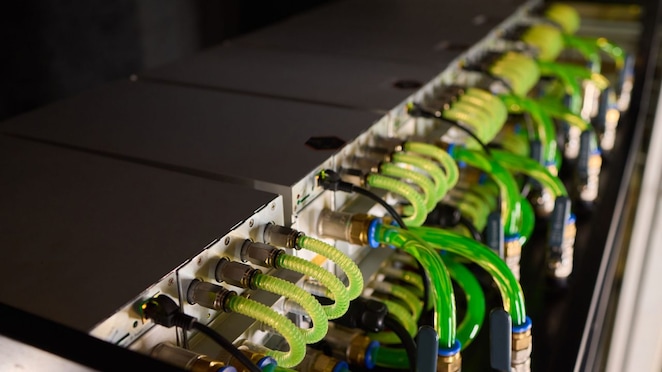
Shell DLC Fluid PG25: A Solution for Data Centers in the AI Era
Shell DLC Fluid PG25 has achieved NVIDIA DSX Ready Coolant Qualification for Direct Liquid Cooling applications. It is designed to be compatible with a wide range of materials and provides corrosion protection for aluminum, brass, cast iron, steel, solder, and copper. Its 2-ethylhexyl acrylate-free formulation helps enhance protection for metal components, rubber, and seals1, while reducing the risk of leakage into electrical equipment. The fluid also helps minimize operational issues that can affect system performance, such as pump failures, scale formation, and silicate gel build-up, while supporting efficient heat transfer and reducing long-term maintenance requirements.
In terms of energy efficiency, Shell DLC Fluid PG25 helps improve Power Usage Effectiveness (PUE), a key data center energy efficiency metric, by up to 27%2. This is further supported by Shell’s global network and technical specialists, helping customers and partners meet their operational needs across different regions.
Extending Expertise Through a Global Network of Data Center Partners
Beyond Direct Liquid Cooling technology, Shell also has extensive experience in developing immersion cooling solutions to support diverse data center configurations and requirements. Shell has worked with partners around the world to develop and deploy these technologies, including Penguin Solutions and AMD in the United States; Asperitas, T-Systems, Penguin Computing, Giga Computing, and Intel in the Netherlands; and Keppel Connectivity in Singapore.
The launch of Shell DLC Fluid PG25 represents another important step in applying Shell’s thermal management expertise, developed through decades of delivering advanced fluid and cooling solutions across industries, to data center solutions. It provides data center operators with an additional option to support the rapid growth of high-performance computing workloads and AI applications.
Shell remains committed to continuous innovation by leveraging its technical knowledge, global R&D network, and cross-industry collaboration to develop technologies that improve operational efficiency, support the growth of the digital economy, and create value for businesses, the public sector, and consumers alike. This reinforces Shell’s commitment to delivering high-quality products and solutions that customers can trust, under the promise: “You Can Be Sure of Shell.”
Notes for Editors
1 Based on electrochemical tests performed with competitor fluids in the US market
2 Compared with the PUE of air cooling
For media enquiries, please contact:
Sudarat Peetakanont
Deputy Executive Director Government and Corporate Relations
The Shell Company of Thailand Limited
Cautionary Note
The companies in which Shell plc directly and indirectly owns investments are separate legal entities. In this press release “Shell”, “Shell Group” and “Group” are sometimes used for convenience to reference Shell plc and its subsidiaries in general. Likewise, the words “we”, “us” and “our” are also used to refer to Shell plc and its subsidiaries in general or to those who work for them. These terms are also used where no useful purpose is served by identifying the particular entity or entities. ‘‘Subsidiaries’’, “Shell subsidiaries” and “Shell companies” as used in this press release refer to entities over which Shell plc either directly or indirectly has control. The terms “joint venture”, “joint operations”, “joint arrangements”, and “associates” may also be used to refer to a commercial arrangement in which Shell has a direct or indirect ownership interest with one or more parties. The term “Shell interest” is used for convenience to indicate the direct and/or indirect ownership interest held by Shell in an entity or unincorporated joint arrangement, after exclusion of all third-party interest.
Forward-Looking statements
This press release contains forward-looking statements (within the meaning of the U.S. Private Securities Litigation Reform Act of 1995) concerning the financial condition, results of operations and businesses of Shell. All statements other than statements of historical fact are, or may be deemed to be, forward-looking statements. Forward-looking statements are statements of future expectations that are based on management’s current expectations and assumptions, including (without limitation) those concerning Shell’s strategy and operating plans, macroeconomic conditions, future energy demand, supply and product mix, commodity prices, demand for Shell’s products, production results and reserve estimates, development, execution and management of projects, energy transition and climate change, management of safety and environmental risks, costs, cash capital expenditures, technology advancements, legislative, judicial, fiscal and regulatory developments, regional conflicts and trading conditions, and involve known and unknown risks and uncertainties that could cause actual results, performance or events to differ materially from those expressed or implied in these statements. Forward-looking statements include, among other things, statements concerning the potential exposure of Shell to market risks and statements expressing management’s expectations, beliefs, estimates, forecasts, projections and assumptions. These forward-looking statements are identified by their use of terms and phrases such as “aim”; “ambition”; ‘‘anticipate’’; “aspire”, “aspiration”, ‘‘believe’’; “commit”; “commitment”; ‘‘could’’; “desire”; ‘‘estimate’’; ‘‘expect’’; ‘‘goals’’; ‘‘intend’’; ‘‘may’’; “milestones”; ‘‘objectives’’; ‘‘outlook’’; ‘‘plan’’; ‘‘probably’’; ‘‘project’’; ‘‘risks’’; “schedule”; ‘‘seek’’; ‘‘should’’; ‘‘target’’; “vision”; ‘‘will’’; “would” and similar terms and phrases. There are a number of factors that could affect the future operations of Shell and could cause those results to differ materially from those expressed in the forward-looking statements included in this press release, including (without limitation): (a) price fluctuations in crude oil and natural gas; (b) changes in demand for Shell’s products; (c) currency fluctuations; (d) drilling and production results; (e) reserves estimates; (f) loss of market share and industry competition; (g) environmental and physical risks, including climate change; (h) risks associated with the identification of suitable potential acquisition properties and targets, and successful negotiation and completion of such transactions; (i) the risk of doing business in developing countries and countries subject to international sanctions; (j) legislative, judicial, fiscal and regulatory developments including tariffs and regulatory measures addressing climate change; (k) economic and financial market conditions in various countries and regions; (l) political risks, including the risks of expropriation and renegotiation of the terms of contracts with governmental entities, delays or advancements in the approval of projects and delays in the reimbursement for shared costs; (m) risks associated with the impact of pandemics, regional conflicts, such as the Russia-Ukraine war and the conflict in the Middle East, and a significant cyber security, data privacy or IT incident; (n) the pace of the energy transition; and (o) changes in trading conditions. No assurance is provided that future dividend payments will match or exceed previous dividend payments. All forward-looking statements contained in this press release are expressly qualified in their entirety by the cautionary statements contained or referred to in this section. Readers should not place undue reliance on forward-looking statements. Additional risk factors that may affect future results are contained in Shell plc’s Form 20-F for the year ended December 31, 2025 (available at www.shell.com/investors/news-and-filings/sec-filings.html and www.sec.gov). These risk factors also expressly qualify all forward-looking statements contained in this press release and should be considered by the reader. Each forward-looking statement speaks only as of the date of this press release, 16 November 2026. Neither Shell plc nor any of its subsidiaries undertake any obligation to publicly update or revise any forward-looking statement as a result of new information, future events or other information. In light of these risks, results could differ materially from those stated, implied or inferred from the forward-looking statements contained in this press release.
Shell’s net carbon intensity and net-zero emissions target
In this press release we may refer to Shell’s “net carbon intensity” (NCI), which includes Shell’s carbon emissions from the production of our energy products, our suppliers’ carbon emissions in supplying energy for that production and our customers’ carbon emissions associated with their use of the energy products we sell. Shell’s NCI also includes the emissions associated with the production and use of energy products produced by others which Shell purchases for resale. Shell only controls its own emissions. The use of the terms Shell’s “net carbon intensity” or NCI is for convenience only and not intended to suggest these emissions are those of Shell plc or its subsidiaries.
Shell’s operating plan and outlook are forecasted for a three-year period and ten-year period, respectively, and are updated every year. They reflect the current economic environment and what we can reasonably expect to see over the next three and ten years. Accordingly, the outlook reflects our combined Scope 1 and 2 target, NCI target and our oil products ambition over the next ten years. However, Shell’s operating plan and outlook cannot reflect our 2050 net-zero emissions target, as this target is outside our planning period. Such future operating plans and outlooks could include changes to our portfolio, efficiency improvements and the use of carbon capture and storage and carbon credits. In the future, as society moves towards net-zero emissions, we expect Shell’s operating plans and outlooks to reflect this movement. However, if society is not net zero in 2050, as of today, there would be significant risk that Shell may not meet this target.
The information provided above regarding Shell’s NCI and net zero emissions target are not intended, nor should they be construed as introducing, suggesting or making any claim, target or representation thereof other than what is included in the press release.
Forward-Looking non-GAAP measures
This press release may contain certain forward-looking non-GAAP measures. We are unable to provide a reconciliation of these forward-looking non-GAAP measures to the most comparable GAAP financial measures because certain information needed to reconcile those non-GAAP measures to the most comparable GAAP financial measures is dependent on future events some of which are outside the control of Shell, such as oil and gas prices, interest rates and exchange rates. Moreover, estimating such GAAP measures with the required precision necessary to provide a meaningful reconciliation is extremely difficult and could not be accomplished without unreasonable effort. Non-GAAP measures in respect of future periods which cannot be reconciled to the most comparable GAAP financial measure are calculated in a manner which is consistent with the accounting policies applied in Shell plc’s consolidated financial statements. These forward-looking non-GAAP measures are provided to assist readers in understanding management’s use and expectations of such measures and may not be appropriate for other purposes.
The contents of websites referred to in this press release do not form part of this press release.
We may have used certain terms, such as resources, in this press release that the United States Securities and Exchange Commission (SEC) strictly prohibits us from including in our filings with the SEC. Investors are urged to consider closely the disclosure in our Form 20-F, File No 1-32575, available on the SEC website www.sec.gov.